




11/08/2026
New Pegs, New Tricks: KHE Pegs for Street, Park, and Flatland
BMX pegs are among the most distinctive add-on parts of a freestyle BMX. Mounted on the wheel axles, these cylindrical extensions make grinds and stalls possible, serve as additional standing platforms in flatland and open up a wide range of tricks that would not be possible without pegs.
Modern pegs differ considerably in terms of material, surface and construction. A lightweight aluminium peg behaves differently from a model with a plastic sleeve, while a smooth grind peg has different requirements from a peg with a particularly grippy surface.
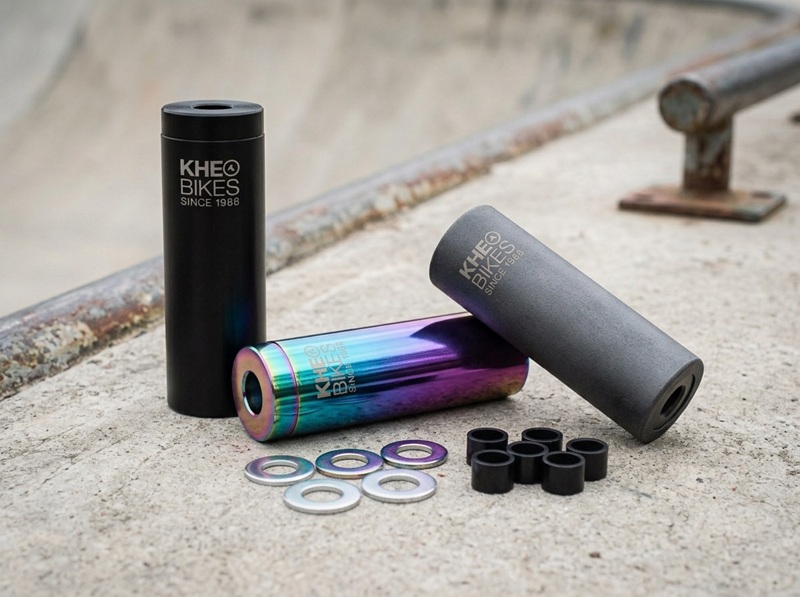
With the KHE LASER CNC, the LASER PRO and the 2ND PRO, we are introducing three different models for 2026.
It all started with pegs at KHE
Pegs have not just been part of KHEbikes for a few years – they are right at the beginning of our history.
When Thomas and Wolfgang Göring founded KHEbikes in 1988, the so-called Do-Pegs were the very first KHE product. Thomas manufactured the first examples himself at home on a small lathe, which even meant that some of the pegs were slightly different in length.
The Do-Pegs and the foot pegs that followed were well received within the BMX scene. Their success became one of the key impulses behind the founding and further development of KHEbikes.
Modern pegs naturally look very different today. CNC manufacturing, lightweight aluminium alloys, adapters for different axle diameters and specialised grind surfaces show just how much this originally simple BMX component has evolved technically.
What are BMX pegs?
Pegs are elongated, usually cylindrical components mounted on the front or rear axle of a BMX bike. They extend beyond the side of the wheel and create additional contact and standing surfaces.
Their purpose varies depending on the BMX discipline.
In street BMX, pegs are mainly used for grinds on rails, ledges and curbs. In park riding, they add further possibilities for grind and stall combinations on suitable obstacles.
In flatland, they serve a different purpose. Here, pegs are mainly used as additional standing points for balance, rolling and spinning tricks. This is why flatland BMX bikes are often equipped with four pegs.
In dirt BMX, on the other hand, pegs usually play only a minor role because jumps, speed and controlled landings are the main focus.
What types of BMX pegs are available?
The main differences are in the material, surface and construction.
Steel and CrMo pegs
Traditional steel or CrMo pegs are particularly known for their high durability. This makes them an interesting choice for intensive street sessions and riders who place a high priority on strength.
The disadvantage is their comparatively high weight. The difference can become particularly noticeable when four heavy pegs are fitted to a BMX.
Aluminium pegs
Aluminium allows for a significantly lighter construction. Aluminium pegs are therefore especially suitable for riders who want to keep the overall weight of their BMX as low as possible.
They are used for street and park as well as technical freestyle and flatland riding.
Pegs with a plastic sleeve
Another design combines a strong metal core with an outer plastic or polycarbonate sleeve.
The main focus here is the sliding performance. A plastic sleeve can glide smoothly across many suitable grind surfaces and generally produces less noise on contact than a solid metal peg.
This design is therefore particularly interesting for riders who spend a lot of time grinding rails and ledges.
Smooth or knurled pegs?
The material is not the only factor that determines how a peg performs. Its surface also plays an important role.
A knurled or particularly grippy surface gives the rider's shoes additional grip. This is especially useful in flatland, where many tricks involve standing directly on the pegs and balancing the bike from there.
The requirements for grinding are almost the opposite.
Here, the peg should slide across the surface in a controlled manner. A heavily textured surface would create additional friction. This is why smooth pegs are particularly suitable for grinds and slides.
The most suitable surface therefore depends directly on the intended use: maximum grip for standing and balance tricks, or smooth sliding performance for grinds.
What is the difference between slide-on pegs and threaded pegs?
There are also different mounting systems when it comes to installing pegs.
Simple threaded pegs have a matching thread directly inside the peg. The complete peg is screwed onto the axle thread. This means that the internal thread of the peg must match the axle exactly.
With slide-on pegs, the peg is pushed over the axle and then secured using the axle nut.
This construction allows more flexible adaptation to different axle diameters. With suitable adapters, the same peg can be used with different BMX hubs.
This is particularly practical because the front and rear wheels of a BMX often use different axle diameters.
Before installation, it is still essential to check that the peg, adapter, axle diameter and available axle length are compatible. After the peg has been fitted, the axle nut must still be able to engage fully and be securely tightened.
KHE LASER CNC – lightweight aluminium peg in black
The KHE LASER CNC is a lightweight, classic black peg made from CNC-machined 7005 aluminium.
At approximately 4.33 inches (110 mm) long and 1.46 inches (37 mm) in diameter, it provides a generous contact area for grinds, stalls and technical tricks. At the same time, the weight remains very low at just 0.44 lbs (200 g) per pair.
Thanks to the included adapters and washers, the set is compatible with 10 mm, 12 mm and 14 mm axles.
This makes the LASER CNC a versatile option for riders looking for a lightweight metal peg with a clean appearance for street, park or technical freestyle tricks.
KHE LASER PRO – lightweight aluminium with an Oil Slick finish
The KHE LASER PRO is aimed at riders who want to combine the benefits of a lightweight aluminium peg with a more striking appearance.
This model is also made from CNC-machined 7005 aluminium and measures 4.33 inches (110 mm) in length. The pair weighs only 0.44 lbs (200 g).
Its defining feature is the Oil Slick finish, which displays different colours depending on the light and gives the BMX a much more distinctive appearance.
Adapters for 10 mm, 12 mm and 14 mm axles allow the pegs to be used with different BMX hubs.
KHE 2ND PRO – designed for grinds and slides
With the KHE 2ND PRO, sliding performance is the main focus.
The model combines a strong metal core with a polycarbonate sleeve. The outer plastic surface is particularly suitable for controlled slides and grinds and behaves differently on many suitable surfaces compared with a traditional metal peg.
Grinding with a plastic sleeve is also generally quieter.
The 2ND PRO measures 4.33 inches (110 mm) in length and has a slightly larger diameter of approximately 1.57 inches (40 mm). The pair weighs 0.66 lbs (298 g) and can also be used with 10 mm, 12 mm and 14 mm axles.
This makes the model particularly suitable for street and park riders whose riding style includes a strong focus on grind tricks.
Which tricks can you do with BMX pegs?
Pegs significantly expand the range of tricks possible on a BMX. Street and park riding in particular offer numerous grind variations.
Some of the best-known peg tricks include:
- Double Peg Grind
- Feeble Grind
- Smith Grind
- Ice Pick Grind
- Toothpick Grind
- Crooked Grind
- 50-50 Grind
- various Peg Stalls
During a Double Peg Grind, two pegs are in contact with the obstacle at the same time.
In a Feeble Grind, the rear peg is typically used while the front wheel runs above or alongside the obstacle. In a Smith Grind, on the other hand, the front peg is used.
Ice Pick and Toothpick tricks each focus on a single peg and already require considerably more balance and bike control.
In flatland, pegs are mainly used as standing and balancing points instead of for grinding. This enables rolling, spinning and balance tricks as well as complex combinations in which the rider moves between the front and rear wheel and the individual pegs.
Want to learn your first BMX tricks yourself? In our beginner videos we show you step by step how to get started with the most important fundamentals.
Why do some BMX riders only use two pegs?
A BMX equipped with pegs does not automatically need four of them.
In street riding in particular, many riders use only two pegs on one side of the bike. The reason is their personal riding style.
Many riders have a preferred grind side and perform most of their tricks on that side. In this case, one peg is usually fitted to the front and one to the rear on the same side.
Compared with four pegs, this saves weight and keeps the opposite side of the BMX clear.
Riders who grind on both sides or deliberately train switch tricks can benefit from using four pegs.
Four pegs are especially common in flatland because riders need as many different standing positions as possible around the front and rear wheels.
There is therefore no universally correct number. The peg setup should match the discipline and the rider's individual style.
Which side is the right grind side?
Riders who want to start with two pegs often wonder which side they should mount them on.
The preferred grind side is not necessarily the same as the rider's front foot when riding normally. Some riders grind on the same side as their front foot, while others prefer the opposite side.
The easiest way to find out is to try simple, low peg stalls. The side on which approaching, hopping and landing feels more natural and controlled is usually a good starting point.
The setup can always be expanded later.
Are pegs also suitable for BMX beginners?
Pegs are not just for professionals. However, riders should already have a certain level of basic control over their BMX before starting to learn grind tricks.
A controlled Bunny Hop is particularly important. The rider should be able to lift the BMX reliably and place it down again in a controlled way.
Low obstacles specifically intended for grinding are ideal for the first attempts. Simple Peg Stalls or low Double Peg Grinds are a much more suitable introduction than high rails.
As confidence and control improve, riders can gradually progress to additional tricks and combinations.
In flatland, pegs can be used for basic balance exercises at a relatively early stage. Here, the focus is initially less on grinding and more on controlled standing and movement on the bike.
Want to learn the Bunny Hop and other fundamental BMX tricks? Our Beginner Tricks show you how – explained clearly and ideal for getting started.
What should you pay attention to when riding with pegs?
Grinding places additional forces on the axles, hubs and wheels. Correct installation and regular checks of the BMX are therefore particularly important.
Before riding, check the following:
- Are the pegs and axle nuts securely tightened?
- Do the peg and adapter correctly match the axle diameter?
- Is there sufficient axle length for secure installation?
- Are the wheel, spokes and hub in good condition?
- Are the pegs or peg sleeves still sufficiently intact?
- Is the obstacle actually suitable and intended for grinding?
For intensive use, hub guards can also be a useful addition. They help protect parts of the hub and, depending on the setup, the spokes from direct contact with rails and ledges.
A helmet and suitable protective equipment are also recommended when learning new grind tricks.
Which peg is right for your BMX?
The right peg depends primarily on your discipline and riding style. Riders who spend a lot of time riding street and park and focus on grinds should pay particular attention to smooth sliding performance. For flatland, low weight, sufficient standing area and grip are more important.
There is also no fixed rule when it comes to the number of pegs: two pegs can be completely sufficient for a street setup focused on one grind side, while four pegs offer maximum versatility for switch tricks and flatland.
With the KHE LASER CNC, LASER PRO and the 2ND PRO, different solutions are available for different requirements. In the end, it is not about fitting as many pegs as possible to your BMX, but about choosing a setup that matches your tricks and your personal riding style.
Want to equip your BMX with the right pegs? Discover our complete range of KHE BMX pegs and find the model that best suits your riding style and setup.
Still unsure which pegs are right for you? Feel free to contact our service team and get personal advice.

.jpg "null")


