



10/09/2026
New Bars, New Setup: KHE BMX Handlebars for Street, Park, and Flatland
The BMX handlebar is one of the most important components of a freestyle BMX bike. Usually simply called a “bar” in the BMX scene, it has a major influence on how the bike feels when steering, jumping, doing manuals, spins, and technical tricks.
BMX handlebars differ in much more than just their appearance. Height, width, backsweep, upsweep, material, weight, and the construction as a 2-piece or 4-piece bar all influence the setup. A lightweight aluminum handlebar feels different from a classic CrMo bar: more direct, agile, and often noticeably lighter at the front. The height is also immediately noticeable. A 9-inch bar keeps the upper body more compact over the bike, while a 10-inch bar provides more room and positions the hands noticeably higher.
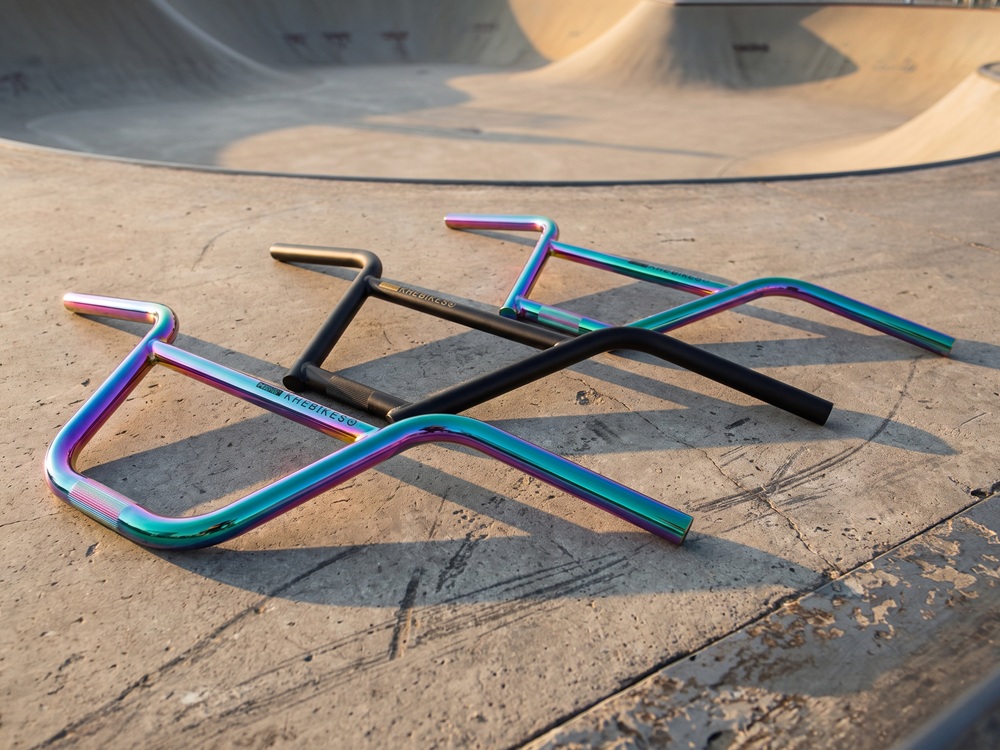
With the KHE PRISM 9" Oil Slick, the PRISM 9" 4-Piece Oil Slick, the particularly lightweight STYLUS 9" aluminum handlebar, the MVP 9" 4-Piece and the tall PLASM XL 10", we are introducing five new BMX handlebars for 2026, each with a different focus. In this blog post, we explain the differences, which bar suits which setup, and what is important when choosing and installing a BMX handlebar.
Why is a BMX handlebar also called a “bar”?
The term “bar” comes from the English word “handlebar”. “Handle” refers to the part held by the hands, while “bar” means a rod or tube. Over time, the shortened term “bar” became established in BMX and cycling.
For this reason, BMX riders almost always simply refer to the handlebar as the bar. The term can also be found in numerous BMX tricks.
The best-known example is the barspin, where the handlebar is rotated a full 360° during the trick. Over the years, numerous variations and combinations have developed from it.
Typical tricks involving the bar include:
- Barspin
- Double Barspin
- Busdriver
- Truckdriver
- X-Up
- Barspin to Manual
- Tailwhip to Barspin
- Barspin-Tailwhip combinations
A particularly demanding combination is the Twix, where a tailwhip and barspin are performed simultaneously. KHE MAC Team rider Justin Dowell is particularly well known for this trick.
Especially with tricks such as barspins, it becomes clear how important a personal handlebar setup is. Height, width, position, and the entire cockpit need to feel natural for the rider.
KHE and the Development of the First Multiple-Butted BMX Handlebar
BMX handlebars have played an important role in the history of KHEbikes for many years. Back in 2004, KHE worked together with then KHE Team rider and three-time X Games pro Shaun Butler to develop the first “Multiple Butted” BMX handlebar.
The goal was clear: a BMX handlebar needed enough material in the areas exposed to the highest loads without being unnecessarily heavy along the entire length of the tubing.
The result was the KHE Butler Lite Bar, which used different wall thicknesses inside the tubes. This construction saved around 300 to 400 grams compared with conventionally constructed handlebars.
The basic idea is still relevant today: material should be used as precisely as possible where it is actually needed. This development also forms the basis for the butted and multiple-butted constructions used in some of our current BMX handlebars.
What Makes a BMX Handlebar Different?
A BMX handlebar is specifically designed for the loads and movements involved in BMX riding. Unlike conventional bicycle handlebars, it has a high rise and an additional crossbar or a correspondingly reinforced construction.
This creates the characteristic BMX shape. At the same time, a freestyle handlebar needs to withstand high loads during bunny hops, landings, spins, and other tricks.
The following factors are particularly important when choosing a BMX handlebar:
- Height or rise
- Width
- Backsweep
- Upsweep
- Material
- Weight
- 2-piece or 4-piece construction
- Compatible handlebar clamp diameter
2-Piece or 4-Piece: What Is the Difference Between BMX Handlebars?
BMX handlebars are often available as 2-piece or 4-piece bars. The designation describes how many main tube sections are used in the construction.
On a classic 2-piece bar, a bent main tube forms most of the handlebar. A crossbar is added to it. This creates the familiar rounded and comparatively clean BMX look.
A 4-piece bar is constructed from several straighter tube sections. This creates the more angular appearance that has been popular in street and flatland riding for many years.
It is important to note that four tubes do not automatically mean higher quality or a stronger BMX handlebar.
The number of tubes alone is not an indication of quality. The material used, tube wall thicknesses, workmanship, welds, and overall construction are much more important.
Today, choosing between 2-piece and 4-piece is therefore largely a question of the desired look and personal riding feel.
Our two new PRISM Oil Slick handlebars demonstrate this difference particularly well: both feature the eye-catching Oil Slick finish, but their 2-piece and 4-piece constructions give them completely different appearances.
What Do the Measurements of a BMX Handlebar Mean?
In addition to the construction, rise, width, backsweep, and upsweep are the main factors that determine how a BMX handlebar feels on the bike.
What Does the Height in Inches Mean on a BMX Handlebar?
BMX handlebar height is usually specified as rise in inches.
A 9-inch BMX handlebar has a rise of approximately 228.6 mm, while a 10-inch bar has a rise of 254 mm.
Handlebar height affects the position of the hands and therefore the entire BMX cockpit. A higher BMX handlebar raises the hands and also changes the leverage when lifting and moving the bike.
For this reason, many taller riders prefer higher bars. However, body height alone does not determine the correct handlebar height. Frame geometry, stem, spacers, and, above all, personal riding feel also play an important role.
9 inches is a very popular standard size for modern freestyle BMX setups. Riders who intentionally want a higher front end or prefer more height due to their body size can choose a 10-inch BMX handlebar.
How Important Is BMX Handlebar Width?
Handlebar width also affects handling.
A wider BMX handlebar provides more leverage and can offer a controlled feel during manuals, jumps, and landings. At the same time, width changes the position of the arms and shoulders.
For this reason, there is no single perfect width for every rider.
Our five new KHE handlebars range from 720 to 750 mm in width, covering different preferences and riding styles.
A handlebar should not simply be shortened, drilled, or otherwise modified without authorization. The relevant manufacturer's specifications and safety instructions must always be observed.
What Is Backsweep on a BMX Handlebar?
Backsweep describes how far the grip sections of the handlebar angle backward toward the rider when viewed from above.
A value of 10°, for example, means that the grip sections do not extend perfectly straight out to the sides but are angled slightly backward.
This changes the position of the hands and wrists. Depending on the model, our new KHE BMX handlebars have a backsweep of 10 or 11 degrees.
What Is Upsweep on a BMX Handlebar?
Upsweep describes the upward angle of the grip sections.
At 0°, the grip sections would run completely horizontally when viewed from the front. A small amount of upsweep raises the outer sections slightly and also changes the position of the hands and wrists.
Depending on the model, our new KHE handlebars have 1 or 2 degrees of upsweep.
CrMo or Aluminum: Which Material Is Better for a BMX Handlebar?
Different materials are used for BMX handlebars. One of the most common is chromoly steel, commonly referred to as CrMo.
High-quality 4130 CrMo steel offers a good balance of strength, durability, and weight and has therefore been used for BMX frames, forks, and handlebars for many years.
Most of our new bars use CrMo constructions.
The KHE STYLUS handlebar differs from many other BMX bars because of its material: it is made from 6061-T6 aluminum and weighs only around 498 grams. It is therefore particularly suitable for riders who place a high priority on very low overall weight and an agile front end. This can be especially interesting for technical flatland riding.
However, aluminum is not fundamentally better than CrMo, nor is CrMo fundamentally better than aluminum. Both materials enable different constructions and place the emphasis on different characteristics.
What Does “Butted Tubes” Mean on a BMX Handlebar?
A butted tube has different wall thicknesses along its length rather than the same wall thickness throughout. The wall thickness is deliberately adjusted in specific areas.
A classic butted tube generally has:
- thicker walls at the more heavily loaded ends,
- thinner walls in the less heavily stressed center section,
- a smooth transition between these areas.
On a BMX handlebar, this means that the tube ends can be made stronger, for example, because particularly high forces are transferred into the clamping areas, welds, and transitions to the other tubes. Material can be saved in the center section of the handlebar if the loads there are lower.
These different wall thicknesses are normally not visible from the outside. They are located inside the tube, meaning that the tube can look just like a conventional tube with a uniform wall thickness from the outside.
What Does “Multiple-Butted Tubes” Mean?
Multiple-butted tubes go one step further. The term means that a tube does not have only two different wall thicknesses but is divided into several sections with differently optimized wall thicknesses along its length.
A multiple-butted tube can, for example, consist of the following zones:
- reinforced tube end for high loads around the clamping or welding area,
- reduced wall thickness in a less heavily loaded section,
- another reinforced transition area where the load increases again,
- possibly another thinner or thicker section at a different point along the tube.
The wall thickness is therefore not simply reduced once from “thick” to “thin.” It can be adjusted specifically at several points. This makes it possible to match the material even more precisely to the actual load distribution of the handlebar.
Five New KHE BMX Handlebars for Different Setups
KHE PRISM 9" Oil Slick – Classic 2-Piece Bar with an Eye-Catching Finish
The KHE PRISM 9" Oil Slick combines the classic rounded 2-piece appearance with a particularly eye-catching new finish.
Depending on the light, the Oil Slick surface displays different color tones, turning the handlebar into a real eye-catcher on the BMX bike.
The PRISM has a 9-inch rise, 720 mm width, 11° backsweep, and 2° upsweep. The CrMo construction weighs around 1040 g and is designed for freestyle, street, park, and dirt riding.
This makes it particularly interesting for riders looking for a classic 2-piece BMX handlebar who also want to make a noticeable visual change to their bike.
KHE PRISM 9" 4-Piece Oil Slick – Distinctive Shape in New Colors
Riders who want to combine the Oil Slick look with a more angular shape will find the KHE PRISM 9" 4-Piece Oil Slick to be the ideal alternative.
The 4-piece construction creates the typical 4-piece silhouette. With a 9-inch rise, 736 mm width, 10° backsweep, and 2° upsweep, it features modern freestyle geometry.
The handlebar is made from 4130 CrMo with butted tubes and weighs around 1080 g.
The main difference compared with the 2-piece PRISM is therefore not a question of “better or worse,” but rather its construction, geometry, and, above all, appearance.
KHE STYLUS 9" – Only 498 g for Technical Setups
At only around 498 g, the KHE STYLUS Flatland 9" is by far the lightest of the five new handlebars.
This is made possible by its 6061-T6 aluminum construction. The bar is 736 mm wide, has 10° backsweep, and a comparatively flat upsweep of 1°.
The STYLUS is therefore particularly aimed at flatland riders and riders who deliberately want to reduce weight at the front of the bike. A lightweight setup can be especially interesting for fast changes of direction, spins, and technical combinations.
KHE MVP 9" 4-Piece – Lightweight CrMo Bar with Butted Tubes
The KHE MVP 9" demonstrates particularly well what can be achieved with an optimized CrMo construction.
Despite using 4130 CrMo and a 4-piece construction, the handlebar weighs only around 850 g. This is made possible in part by the butted tubes with different wall thicknesses.
With a width of 736 mm, 9-inch rise, 10° backsweep, and 2° upsweep, the MVP combines modern BMX geometry with comparatively low weight.
It is therefore an interesting choice for riders looking for a lightweight CrMo BMX handlebar while still preferring the typical 4-piece appearance.
KHE PLASM XL 10" – Tall BMX Handlebar with Plenty of Rise
The KHE PLASM XL is the largest bar in our new range.
With a 10-inch or 254 mm rise and 750 mm width, it provides a noticeably higher and wider position than the 9-inch models.
It is made from 4130 CrMo, uses multiple-butted technology, and weighs around 1080 g.
The PLASM XL is therefore particularly suitable for taller riders and riders who deliberately prefer a high BMX handlebar with plenty of leverage.
Which BMX Handlebar Is Right for Me?
The right BMX handlebar mainly depends on body height, preferred handlebar height, riding style, material, weight, and personal riding feel.
Riders looking for a classic 2-piece appearance will find a suitable option in the PRISM 9". The PRISM 4-Piece offers a more angular alternative and combines this shape with the new Oil Slick finish.
Anyone particularly focused on weight and looking to build a technical flatland setup should take a closer look at the STYLUS. The MVP, on the other hand, offers an interesting middle ground for riders looking for a lightweight CrMo 4-piece bar.
For taller riders or riders who deliberately want a higher front end, the PLASM XL offers the greatest handlebar height of these five models with its 10-inch rise.
The important point is not which model is “the best” on paper. The right BMX handlebar is the one whose geometry matches your body, your bike, and your personal riding style.
How Does the Stem Affect Handlebar Height?
The BMX handlebar itself is not the only factor that determines how high the cockpit feels. The stem also has a major influence.
BMX bikes mainly use topload and frontload stems.
A topload stem clamps the handlebar on top of the stem and therefore generally positions the bar higher. A frontload stem clamps the handlebar farther forward and, with classic designs, usually positions it slightly lower.
However, stem geometries vary. The decisive factors are therefore not simply whether it is called a topload or frontload stem, but the actual rise and reach of the stem.
The actual grip position is therefore determined by several factors: handlebar height, stem height, stem length, spacers, and the angle at which the handlebar is installed.
As a result, the same 9-inch BMX handlebar can feel noticeably different with two different stems.
How Should a BMX Handlebar Be Positioned Correctly?
As a starting position, we recommend aligning the BMX handlebar approximately parallel to the fork legs when viewed from the side. You can find suitable forks here.
This is a common basic setting in BMX and provides a good starting point for finding your personal position.
From there, the bar can be adjusted slightly according to personal riding preference.
Rolling the handlebar slightly forward moves the grips forward and partly upward. Rolling the bar slightly backward brings the hands closer to the rider and also changes the effective grip height.
Extreme positions are generally unnecessary. It makes more sense to start with the parallel position, ride a few laps, and then make small adjustments.
This makes it possible to determine which position feels most natural during bunny hops, manuals, spins, and normal riding.
How Do I Install a BMX Handlebar Correctly?
The installation of a BMX handlebar is generally straightforward, but because of the high loads involved in freestyle riding, it must be carried out carefully.
- Loosen the clamping bolts or stem faceplate and clean the clamping surfaces. The area should be free from dirt and grease.
- Position the BMX handlebar centrally in the stem. The knurled clamping area must sit centrally inside the stem.
- Fit the faceplate and initially tighten the bolts only lightly so that the handlebar can still be aligned.
- When viewed from the side, initially position the bar parallel to the fork.
- Then tighten the bolts gradually and in a cross pattern. The gap around the stem faceplate should remain as even as possible.
- Finally, observe the torque specified by the manufacturer and check that the handlebar does not rotate in the stem even under firm pressure.
The torque specification of the respective stem manufacturer always applies. For suitable KHE setups, we recommend 8 Nm and even tightening in a cross pattern.
After installation, the secure fit should be checked again. After a harder crash or heavy landing, it is also advisable to visually inspect the handlebar for cracks, deformation, or other damage.
What Clamp Diameter Do BMX Handlebars Use?
A 22.2 mm handlebar clamp diameter is very common on classic freestyle BMX handlebars.
All five KHE BMX handlebars presented here also have a clamp diameter of 22.2 mm. They must therefore be combined with a BMX stem designed for this diameter.
Nevertheless, both components should always be checked before changing handlebars. In addition to the classic 22.2 mm standard, oversize systems with larger clamp diameters are also available in BMX.
A handlebar and stem with different clamp diameters must not be combined.
Do All BMX Grips Fit Every BMX Handlebar?
Most classic BMX grips are designed for the standard 22.2 mm grip diameter of a BMX handlebar and can therefore be used on many different BMX bars.
Nevertheless, before purchasing, you should check that the grips are actually designed for the BMX or bicycle standard. Grip length also plays a role, especially if a brake lever is additionally installed on the handlebar.
Before installation, the grip area should be clean and free from oil or grease. Depending on the model, classic rubber grips can be installed using compressed air or a fully evaporating installation aid recommended by the manufacturer. Oil or permanently lubricating substances are unsuitable because they could allow the grip to rotate on the handlebar afterward.
Suitable bar ends on both ends of the handlebar are also particularly important. They close the open tube ends and are an essential part of a safe BMX setup.
If you would like to change your BMX grips yourself, you can also find a step-by-step guide in our KHEbikes WorkShop “Changing Grips”.
Riders who frequently perform barspins and other tricks involving full handlebar rotations should also consider the brake cable setup. A rotor system allows the handlebar to rotate without a standard brake cable becoming increasingly wrapped around the head tube.
The Right Bar Changes Your Entire BMX Setup
2-piece or 4-piece, 9 or 10 inches, CrMo or aluminum: when it comes to BMX handlebars, there is no single construction that is automatically the best choice for every rider.
The number of tubes does not determine quality. Handlebar height should not be selected solely according to body height. And the lightest bar is not automatically the best solution for every riding style.
What matters is the interaction between geometry, material, weight, stem, and personal riding feel.
With our five new BMX handlebars, we deliberately cover a range of different setups: from the classic PRISM 2-Piece to the eye-catching Oil Slick 4-Piece, the ultra-light 498 g STYLUS, the butted MVP and the 10-inch PLASM XL.
This allows you to choose your bar according to exactly how you want to ride your BMX.
If you have any questions or are unsure about our BMX handlebars, the right height, installation, or your setup, you can contact the KHE Service team at any time.


